
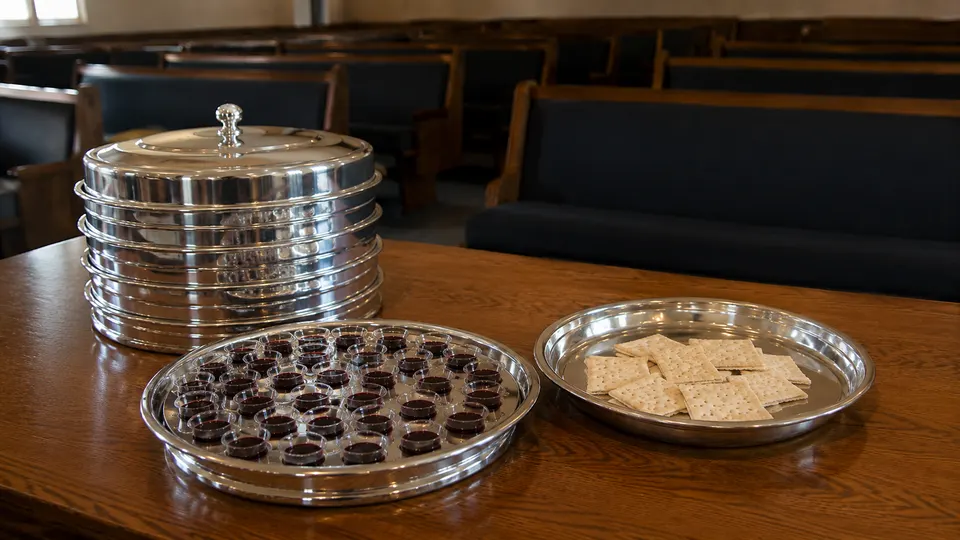
It’s simple and it’s quiet. A man leads a brief prayer of thanks, trays holding small pieces of unleavened bread move down each row, then trays with the fruit of the vine follow, and everyone takes a few minutes to think on the death of Jesus. We do this every Sunday, and it usually lasts only a few minutes. Beyond remembering, there’s no ceremony to it.
If you’ve never watched it happen, or you’re used to something that looks quite different, here’s exactly what takes place and why.
What’s on the tray
Two plain things. The bread is unleavened, meaning it’s made without yeast, more like a thin cracker; that’s the bread Jesus used at the Passover meal where He gave the Supper. The cup holds the fruit of the vine, which is grape juice. Jesus named it that Himself: “I tell you I will not drink again of this fruit of the vine until that day when I drink it new with you in my Father’s kingdom” (). There’s nothing elaborate about any of it, and that’s exactly the point.
What it means
The Lord’s Supper is a memorial Jesus handed His followers the night before He died. Paul passed along Jesus’s own words: “This is my body, which is for you. Do this in remembrance of me” (). Of the cup He said, “This cup is the new covenant in my blood. Do this, as often as you drink it, in remembrance of me” ().
So the bread stands for His body and the cup for His blood. Together they look back to the cross and, as Paul adds, ahead in hope: “For as often as you eat this bread and drink the cup, you proclaim the Lord’s death until he comes” (). It isn’t a snack, and it isn’t a full meal. It’s a moment of remembrance.
Why it’s so quiet
You’ll notice the room grows still during the Supper. That’s because the New Testament frames it as a time to look inward: “Let a person examine himself, then, and so eat of the bread and drink of the cup” (). People bow their heads, pray quietly, or read a passage on their own. No one is putting on a show and no one is watching you. It’s a handful of unhurried minutes set apart for reflection.
Why every Sunday
Plenty of visitors are used to communion once a month or a few times a year, so weekly observance catches them off guard. We keep it because the early church did. Luke wrote, “On the first day of the week, when we were gathered together to break bread, Paul talked with them” (). “To break bread” there most likely points to the Lord’s Supper, and taking it was one reason the Christians came together on the first day of the week. We’d rather hold to that pattern than draw up a schedule of our own.
Doesn’t taking it every week wear it down into routine? For most of us it runs the other direction. It becomes a steady appointment we’d miss if it vanished, a weekly return to the one event that everything else rests on.
What it looks like from your seat as a visitor
You’ll see the trays pass quietly, the bread first and then the cup, handed person to person down the row. When they reach you, you’re completely free to take part or to simply pass them along. The Lord’s Supper is for those who follow Christ, so no one expects a guest to partake, and no one will be watching to see what you do. You’re welcome to sit with your own thoughts and take in the moment.
Keep studying
If you’d like to understand the Lord’s Supper more deeply, the best place to look is the New Testament itself, where Jesus gave it and the first Christians kept it. Read those passages at your own pace, and carry any questions with you when you visit. No one will put you on the spot, and you’re welcome exactly as you are.
You’re Welcome Here
We keep the Supper the way Scripture describes it because we’d rather stand on God’s Word than on our own additions, and at Memorial Church of Christ you’ll always find plain answers straight from the Bible. Plan your visit: /plan-your-visit/ — come as you are, and ask us anything.
If you want to see what the Bible says about becoming a Christian, start here: /how-to-be-saved/.
When we meet:
- Sunday: Bible Class 9:00 am, Worship 10:00 am, Worship 6:00 pm
- Wednesday: Bible Class 7:00 pm