
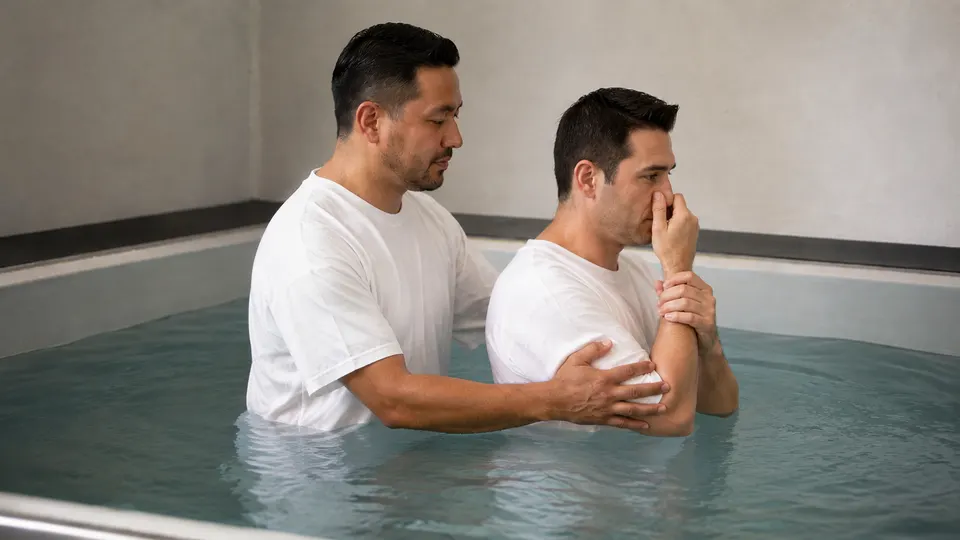
Few spiritual questions feel more personal than being told that your baptism may not have been the baptism described in the New Testament. That day may hold deep meaning for you. You may have acted sincerely, trusted what you were taught, and believed the matter was settled.
Questioning what happened does not have to mean questioning your sincerity. It means returning to Scripture and asking a necessary question: What does God describe as baptism?
Churches of Christ understand New Testament baptism to be the immersion of a person who has heard the gospel, believed in Jesus, and repented of sin. It is done in the name of Jesus Christ for the forgiveness of sins. If an earlier ceremony did not follow that pattern, it deserves careful examination, not as a judgment upon anyone’s heart, but as an effort to obey what God has revealed.
What Does the New Testament Teach About Baptism?
No single conversion account states every truth the New Testament teaches about baptism. When the passages are considered together, however, a clear pattern emerges.
Those baptized heard and believed the gospel:
“But when they believed Philip as he preached good news about the kingdom of God and the name of Jesus Christ, they were baptized, both men and women” ().
They were called to repent:
“Repent and be baptized every one of you in the name of Jesus Christ for the forgiveness of your sins” ().
Baptism is described as a burial and a rising to new life:
“We were buried therefore with him by baptism into death, in order that, just as Christ was raised from the dead by the glory of the Father, we too might walk in newness of life” ().
It is also connected with the washing away of sins. When Saul of Tarsus was told what he needed to do, Ananias said:
“And now why do you wait? Rise and be baptized and wash away your sins, calling on his name” ().
These passages lead us to understand baptism as more than a religious ceremony or a public announcement of something completed earlier. It is a response of trusting obedience in which a believer appeals to God and enters the new life found in Christ (; ).
The New Testament does not make baptism depend upon the building in which it occurs, the name displayed outside, or the educational credentials of the person performing it. The important questions concern the person being baptized, the act itself, and the purpose Scripture gives it.
Did the person believe the gospel and repent? Was the person immersed? Was the baptism understood as the response God commands for the forgiveness of sins?
These questions are not intended to wound anyone. They help us compare our experience with what God’s Word teaches.
Did Anyone in the Bible Need to Be Baptized After a Previous Baptism?
Yes. Acts 19 records an occasion when Paul met a group of disciples in Ephesus who had received John’s baptism.
Paul asked them:
“‘Into what then were you baptized?’ They said, ‘Into John’s baptism.’ And Paul said, ‘John baptized with the baptism of repentance, telling the people to believe in the one who was to come after him, that is, Jesus.’ On hearing this, they were baptized in the name of the Lord Jesus” ().
John’s baptism had come from God and had served an important purpose in preparing people for Christ. But it pointed forward to Jesus. These people needed to understand and receive the baptism given in the name of the Lord Jesus.
Nothing in the passage suggests that they had been dishonest the first time. Their sincerity was not the issue. Once they understood what had been missing, they responded to the truth they had learned.
This account does not answer every possible question about someone’s previous baptism, but it teaches an important principle: it is right to examine a baptism in light of fuller understanding, and there is no shame in obeying God after learning something we did not previously know.
Does This Mean My Faith Was Never Real?
Not necessarily. An incomplete understanding does not prove an insincere heart. Scripture does not give us permission to pronounce judgment upon motives known fully only by God.
If you were sprinkled or christened as an infant, the decision was made for you before you could understand the gospel or believe it for yourself. Your parents may have acted from sincere love and a desire to place your life in God’s hands. Recognizing that infant baptism does not follow the New Testament pattern does not require you to despise their intentions.
If you were immersed as a public testimony after being taught that salvation had already taken place, you may have acted with complete sincerity. The question is not whether you meant what you did. The question is whether the New Testament presents baptism merely as a public announcement of salvation already received or as part of the response through which a believer receives forgiveness and enters Christ.
We believe passages such as , , , , and teach the latter.
Sincerity matters greatly, but sincerity and complete understanding are not always the same. All of us are responsible for allowing God’s Word to correct what we previously believed.
What Should I Do Now?
Begin by reading the relevant passages for yourself. Read Acts 2, Acts 8, Acts 19, Acts 22, Romans 6, Galatians 3, and 1 Peter 3 in their full context.
As you study, consider these questions:
- Who was baptized?
- What had that person heard and believed?
- What action was performed?
- What purpose does the passage connect with baptism?
- How did people respond once they understood what God required?
Do not approach those passages merely looking for support for what you already believe, including what we have told you. Ask what the text itself teaches.
If you conclude that your earlier baptism did not match the baptism described in the New Testament, being immersed upon your own faith and repentance is not a rejection of every sincere step you took before. It is not an insult to your parents or to those who taught you. It is a decision to obey God according to what you now understand.
Nor is there a need for needless delay. In Acts, when people understood and believed the gospel, they responded. When the Ethiopian official saw water, he asked:
“See, here is water! What prevents me from being baptized?” ().
Your decision should arise from faith and conviction, not emotional pressure. Take the question seriously, examine the Scriptures honestly, and then follow what God’s Word teaches.
A Word About Churches of Christ
Churches of Christ have no central earthly headquarters or governing body over every congregation. Therefore, no single congregation can speak officially for all churches using that name.
This article explains what Memorial Church of Christ teaches. Other congregations may express the matter differently. We encourage you to evaluate our teaching in the same way you should evaluate anyone else’s: by comparing it carefully with Scripture.
Keep Studying
Open the Bible without fear. Read the passages in context, pray for wisdom, and take your questions to those who have taught you. You are also welcome to bring those questions to us.
Getting this right matters. But care and patience are not enemies of truth. God is not honored when people are hurried into a decision they do not understand. He is honored when we receive His Word with an honest heart and respond to it in faith.
Examine God’s Word With Us
At Memorial Church of Christ, we would be glad to open the Bible and study this question with you. We will not single you out or ask you to make a decision before you understand what Scripture teaches.
Plan your visit, or bring your questions to us privately. Our desire is not to talk you into something, but to help you hear God’s Word and follow it with confidence.
If you would like to examine what the Bible teaches about becoming a Christian, start here.
When we meet:
- Sunday: Bible Class 9:00 am, Worship 10:00 am, Worship 6:00 pm
- Wednesday: Bible Class 7:00 pm