
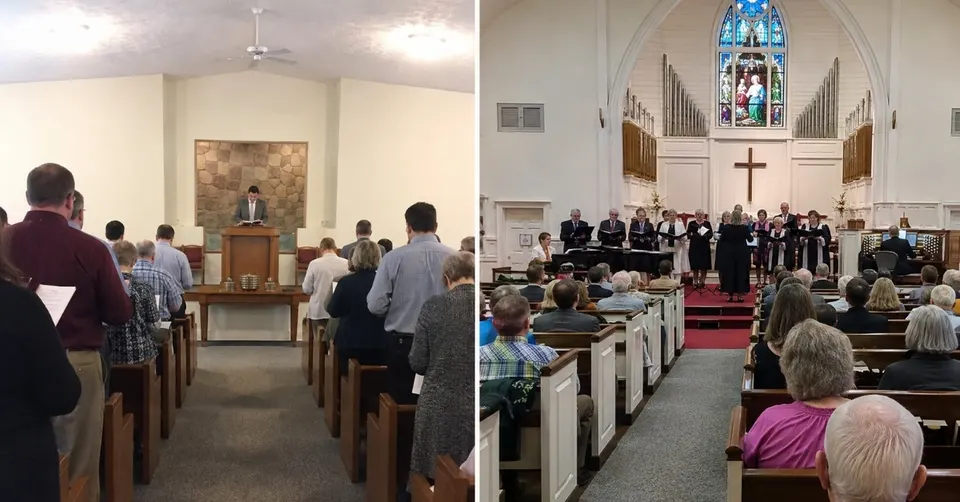
Methodist churches and churches of Christ share important convictions. Both believe in Jesus Christ, value the Bible, and desire to help people live faithfully before God. Many Methodists also serve their neighbors with genuine compassion. That common ground deserves to be acknowledged.
There are, however, significant differences concerning doctrinal authority, church organization, baptism, worship, and the Lord’s Supper. Our purpose is not to speak against sincere people. It is to explain these differences clearly so that readers can examine them in light of Scripture.
Methodism developed through the work of John and Charles Wesley during the eighteenth century. The modern history of churches of Christ is connected with the Restoration Movement, which called people to move beyond denominational divisions and return to the teaching and practice of the New Testament church.
Methodist denominations differ from one another, and churches of Christ have no central governing body. This article therefore describes common Methodist beliefs alongside what we teach and practice at Memorial Church of Christ.
Where Does Final Authority Rest?
Both groups affirm the authority of the Bible, but they differ in how doctrine is formally established and interpreted.
Methodist denominations commonly use documents such as the Articles of Religion, denominational disciplines, and other statements rooted in the Wesleyan tradition. Methodists do not generally consider these writings inspired or equal to Scripture. They are intended to summarize doctrine and guide the teaching, worship, organization, and conduct of the denomination. In practice, however, they function as authoritative standards within that church body.
Churches of Christ do not adopt a creed, catechism, or denominational discipline as a binding standard. We seek to use Scripture alone as the authority for what the church believes and practices.
Paul wrote:
“All Scripture is breathed out by God and profitable for teaching, for reproof, for correction, and for training in righteousness, that the man of God may be complete, equipped for every good work” ().
This does not mean that Christians should never write explanations of biblical teaching. This article itself is such an explanation. It means that no human document carries the authority of God’s Word or has the right to bind upon the church something Scripture does not require.
How Is Each Church Organized?
Methodist churches generally have a connectional form of government. Local congregations belong to a larger denominational structure. Depending on the denomination, bishops or other leaders may oversee geographical regions, ministers may be appointed through conferences, and decisions made by broader governing bodies may apply to local churches.
Churches of Christ have no governing organization above the local congregation. Each mature congregation is overseen by its own elders, men who meet the qualifications given in the New Testament (; ).
Peter instructed elders:
“Shepherd the flock of God that is among you” ().
We understand elders to oversee the local congregation among them rather than governing churches elsewhere. No bishop, conference, convention, or headquarters stands above the congregation. Christ alone is the head of His church ().
Because churches of Christ are locally independent, Memorial cannot speak officially for every congregation using that name. We can explain only what we understand Scripture to teach and what we practice here.
How Do Their Teachings About Baptism Differ?
Methodist churches generally baptize both professing believers and the infant children of Christian families. They commonly administer baptism by sprinkling or pouring, although some Methodist traditions also recognize immersion. Baptism is understood as a sign and means of God’s grace and as an entrance into the covenant community of the church.
Churches of Christ baptize people who have personally heard the gospel, believed in Jesus Christ, and repented of their sins. We practice baptism by immersion and understand it to be part of the believer’s response to God’s saving grace.
Peter told those who had heard and believed the gospel:
“Repent and be baptized every one of you in the name of Jesus Christ for the forgiveness of your sins” ().
Paul described baptism as a burial and a rising to new life:
“We were buried therefore with him by baptism into death, in order that, just as Christ was raised from the dead by the glory of the Father, we too might walk in newness of life” ().
Because faith and repentance precede baptism in the New Testament, we do not baptize infants. Because baptism is pictured as a burial with Christ, we understand immersion to be the action Scripture describes.
We also do not regard baptism merely as a public sign that salvation was received earlier. We understand it as the trusting response in which a repentant believer is united with Christ and receives the forgiveness God has promised (; ).
How Is Worship Different?
Methodist worship varies considerably. Many services include instrumental music, choirs, responsive readings, and a prepared order of worship. Some congregations follow a formal liturgy, while others have a more contemporary style.
Worship at Memorial Church of Christ is simple and congregational. We pray, sing, give voluntarily, observe the Lord’s Supper, and hear teaching from Scripture.
Our singing is a cappella, meaning that the congregation sings without instrumental accompaniment. We follow the New Testament’s instruction:
“Addressing one another in psalms and hymns and spiritual songs, singing and making melody to the Lord with your heart” ().
This is not because we believe musical instruments are inherently sinful. They appear in the Old Testament and can be used appropriately outside the church’s worship. We sing without them because singing is the musical worship the New Testament directs the church to offer.
How Often Is the Lord’s Supper Observed?
The frequency of Communion varies among Methodist congregations. Some observe it weekly, while others do so monthly or according to another schedule.
Churches of Christ generally observe the Lord’s Supper every Sunday. We follow the example recorded in Acts:
“On the first day of the week, when we were gathered together to break bread, Paul talked with them” ().
We understand “breaking bread” in this passage to refer to the Lord’s Supper and to show that the first-century disciples gathered for this purpose on the first day of the week.
Weekly observance does not have to make the memorial ordinary or thoughtless. Its meaning depends upon the hearts of those participating. Each Sunday, it calls Christians back to the body and blood of Jesus and the sacrifice through which we have hope.
How Should You Consider These Differences?
Do not decide only by which congregation feels more familiar, offers the most appealing programs, or has the style of worship you prefer. Those considerations may affect your comfort, but they cannot determine what is true.
Instead, open the New Testament and ask what the first Christians were taught to believe and practice. Examine how their congregations were organized, who was baptized and why, how they worshiped, and what place the Lord’s Supper held in their assemblies.
Do not accept our conclusions without examination. Compare them with Scripture just as carefully as you would examine anyone else’s teaching.
The people of Berea were commended because they were:
“Examining the Scriptures daily to see if these things were so” ().
The best comparison is not one human tradition against another. It is each teaching and practice placed beside God’s Word.
Examine God’s Word With Us
At Memorial Church of Christ, we would be glad to open the Bible and study these questions with you. Our desire is not to win a comparison but to follow Jesus faithfully and help others do the same.
Plan your visit. Come as you are, worship with us, and bring your questions.
If you would like to examine what the Bible teaches about becoming a Christian, start here.
When we meet:
- Sunday: Bible Class 9:00 am, Worship 10:00 am, Worship 6:00 pm
- Wednesday: Bible Class 7:00 pm