
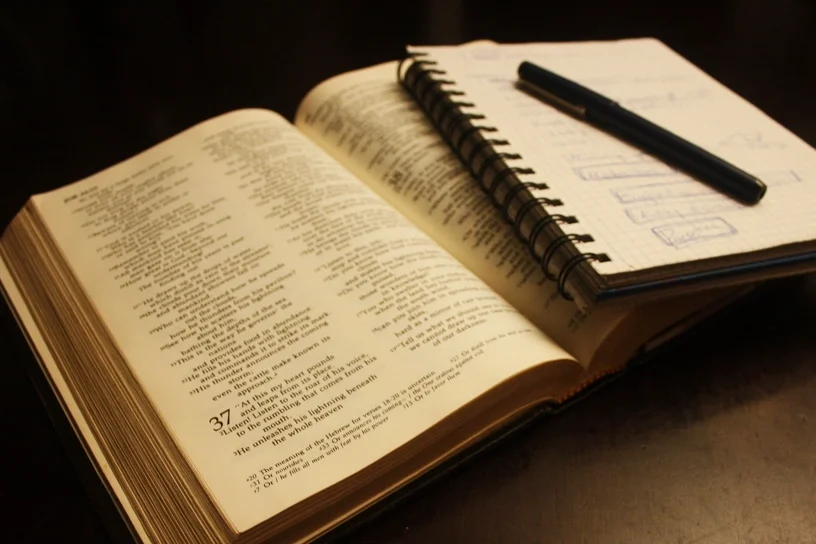
Churches of Christ believe that the Bible is God’s complete and final revealed word. We seek to follow it without adding to it or taking away from it and simply to be Christians—nothing more and nothing less. We have no creed apart from Scripture, no denominational headquarters, and no human founder. Christ is the founder and head of the church.
Throughout this overview, we have included Bible references so you can examine these beliefs for yourself.
The Bible as Our Authority
Every belief and practice in a church of Christ has to come from Scripture. Paul wrote that “All Scripture is breathed out by God and profitable for teaching, for reproof, for correction, and for training in righteousness, that the man of God may be complete, equipped for every good work” (). Complete and equipped means we don’t need a creed book, a catechism, or an annual convention to tell us what to believe. If we can’t find it in the Bible, we don’t teach it. You’ll sometimes hear this said as “we speak where the Bible speaks, and we are silent where the Bible is silent.”
The One Church Jesus Built
Jesus promised, “I will build my church, and the gates of hell shall not prevail against it” (). Church — singular. The New Testament never describes denominations; it describes one body of saved people: “There is one body and one Spirit—just as you were called to the one hope that belongs to your call—one Lord, one faith, one baptism” (). We are not trying to be a better denomination. We are trying not to be one at all — just Christians, belonging to the church you read about in the Bible.
Even our name is a description rather than a brand. Paul told the Romans, “All the churches of Christ greet you” (). Congregations of Christ’s people, identified by the one they belong to.
How Churches of Christ Understand Salvation
Salvation is by God’s grace, through faith in Jesus, and the New Testament shows exactly how people responded to that good news. They heard the gospel, believed it, repented of their sins, confessed Jesus as Lord, and were baptized. When the crowd at Pentecost asked what to do, Peter answered: “Repent and be baptized every one of you in the name of Jesus Christ for the forgiveness of your sins” ().
Notice what baptism is for in that verse: the forgiveness of sins. Churches of Christ practice baptism the way the New Testament describes it — a believer, immersed in water, to be forgiven and added to Christ’s church. It is the point where God washes sins away, not a ceremony performed afterward to announce it.
And salvation begins a life, not just a moment. We believe a Christian can drift and fall away (; ), which is why the Bible is full of encouragement to stay faithful — and why we take encouraging one another seriously.
How Churches of Christ Worship
Our worship follows the pattern of the first Christians, who “devoted themselves to the apostles’ teaching and the fellowship, to the breaking of bread and the prayers” (). Every Sunday we sing together without instruments, we pray, we observe the Lord’s Supper, we hear preaching from the Bible, and we give as we’ve prospered. Singing is a cappella because that is the music the New Testament assigns to the church: voices and hearts. The Lord’s Supper is weekly because the first day of the week is when the early church gathered to take it (see ).
How Congregations Are Organized
Each congregation is independent. There is no headquarters, no regional office, and no hierarchy above the local church. Congregations are led by elders — also called shepherds or overseers — who must meet the qualifications listed in 1 Timothy 3 and Titus 1, served by deacons, and taught by preachers (the Bible also calls them evangelists). No earthly person or office stands between a congregation and Christ.
The Work of the Church
The New Testament gives the church, acting as a body, three works: building up its members (), sharing the gospel with the lost (), and relieving Christians in need from its treasury, as the early congregations did for “the poor among the saints” (; see also ). Those collective works are distinct from the duties of individual Christians, who are taught to do good to everyone as they have opportunity (). That’s where a congregation’s energy and money go. We are not a social club, a concert venue, or an entertainment option — not because those things are evil, but because the church was given a more important job.
What We Do Not Claim
We don’t claim to be perfect people. We claim a perfect standard, and we spend our lives being corrected by it. Any congregation honest with that standard will tell you it is still learning.
Examine These Beliefs for Yourself
Don’t accept this summary — verify it. Open the New Testament, look up every verse above in its context, and weigh what we believe against what you find. That’s not a risk to us; it’s the whole invitation.
Continue Studying With Us
If you have questions, the Memorial church of Christ would be glad to study the Bible with you. You are also welcome to visit one of our worship services and see for yourself what a congregation of the church of Christ is like.
Plan your visit: /plan-your-visit/ — let us know you’re coming and we’ll save you the awkwardness of walking in cold.
Want to know what the Bible says about being saved? Start here: /how-to-be-saved/.
When we meet:
- Sunday: Bible Class 9am · Worship 10am · Worship 6pm
- Wednesday: Bible Class 7pm