
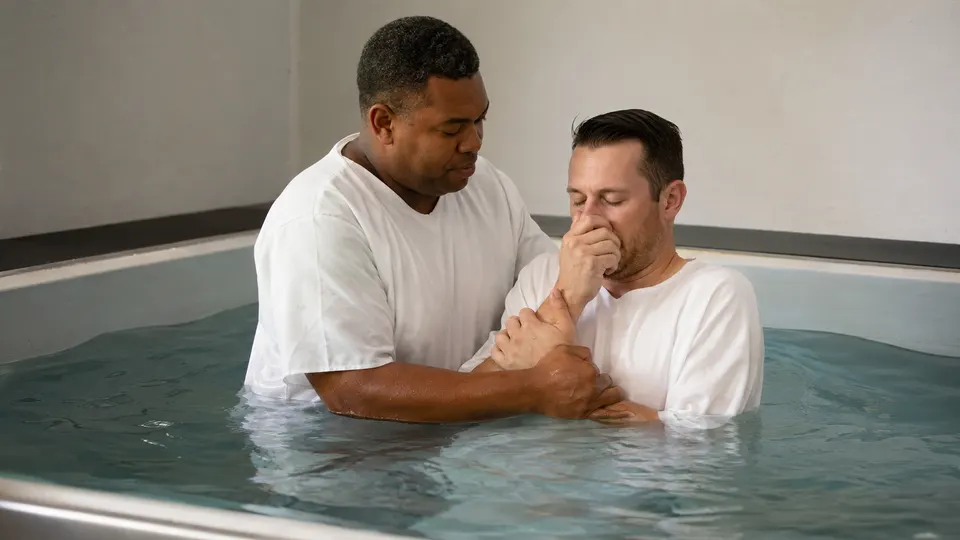
Yes. The New Testament repeatedly connects baptism with salvation and the forgiveness of sins. For that reason, we understand baptism as part of how a person comes to Christ—not merely a symbol added sometime afterward.
If you were taught that baptism is only an outward sign of a salvation that has already occurred, that answer may sound bold. But the question is not what any church says about baptism. It is what the Scriptures say, and the answer deserves an open Bible and careful consideration.
A sincere concern is usually underneath this question: Does making baptism necessary turn salvation into something people earn? That concern deserves a direct answer too.
What the New Testament Actually Says
Begin with the first gospel sermon preached after Jesus’ resurrection. When the people realized their guilt and asked what they should do, Peter answered:
“Repent and be baptized every one of you in the name of Jesus Christ for the forgiveness of your sins, and you will receive the gift of the Holy Spirit” ().
In Peter’s answer, repentance and baptism are connected with the forgiveness of sins.
The same pattern appears in Saul’s conversion. Ananias told him:
“And now why do you wait? Rise and be baptized and wash away your sins, calling on his name” ().
Peter later wrote:
“Baptism, which corresponds to this, now saves you, not as a removal of dirt from the body but as an appeal to God for a good conscience, through the resurrection of Jesus Christ” ().
Peter made clear that baptism is not about washing dirt from the body. Its saving meaning comes through the resurrection of Jesus Christ as a person appeals to God in faith. The power belongs to Christ, but baptism is part of the response Scripture describes.
We are not creating a connection between baptism and salvation. We are trying to respect the connection already present in the text.
Isn’t This Salvation by Works?
No. Salvation is a gift, never a wage. Paul wrote:
“For by grace you have been saved through faith. And this is not your own doing; it is the gift of God, not a result of works, so that no one may boast” ().
Nothing we do purchases forgiveness. Jesus paid the price for sin through his death on the cross.
Baptism does not compete with grace. It is a trusting response to grace. Paul described Christians as having been “buried with him in baptism” and “raised with him through faith in the powerful working of God” (). The person being baptized is not performing an achievement but trusting in God’s work.
Baptism is therefore nothing to boast about. It is an act of surrender in which a person calls on God to do what only God can do.
What Baptism Actually Pictures
The New Testament describes baptism as more than a small religious ceremony. Paul wrote:
“Do you not know that all of us who have been baptized into Christ Jesus were baptized into his death? We were buried therefore with him by baptism into death, in order that, just as Christ was raised from the dead by the glory of the Father, we too might walk in newness of life” ().
Baptism portrays a burial and a rising again. This is why churches of Christ practice immersion in water and baptize people capable of hearing the gospel, believing in Jesus, and repenting of sin.
The water itself has no magical power. Apart from faith, repentance, and Christ’s saving work, immersion is only getting wet. Baptism matters because of the death and resurrection of Jesus and the believer’s trust in him.
Where Baptism Fits in the Whole Picture
Baptism is not the only response involved in coming to Christ, and it never stands alone. In the New Testament, people hear the gospel, believe in Jesus, repent of sin, confess him as Lord, and are baptized. They then begin a life of faithful discipleship.
These are not separate ways of earning salvation. Together, they describe a person turning to Christ in trusting obedience.
When we call baptism necessary, we do not mean it is a magic act or a box to check. We mean the New Testament places it within the conversion of a believing, repentant person. Scripture connects baptism with forgiveness, union with Christ, and new life, and we do not believe we are free to move it until after salvation or reduce it to an optional symbol.
Keep Studying
If you were taught that baptism is only a symbol, we understand why this may sound unfamiliar. We are not asking you to accept our conclusion without examining it.
Read the conversions recorded in Acts and notice how people responded when the gospel was preached. Study , , , , , and . Then consider , , , and in context.
Ask what baptism meant, who received it, and when it occurred.
Weigh It Against the Word
At Memorial Church of Christ, we would be glad to open the Bible and study baptism with you. Bring your questions, examine every passage, and reach your conclusion from Scripture. We want your faith to rest on God’s word—not on pressure, tradition, or anyone’s sales pitch.
Plan your visit: /plan-your-visit/ — come as you are, and ask us anything.
If you want to see for yourself what the Bible says about becoming a Christian, start here: /how-to-be-saved/.
When we meet:
- Sunday: Bible Class 9am, Worship 10am, Worship 6pm
- Wednesday: Bible Class 7pm