
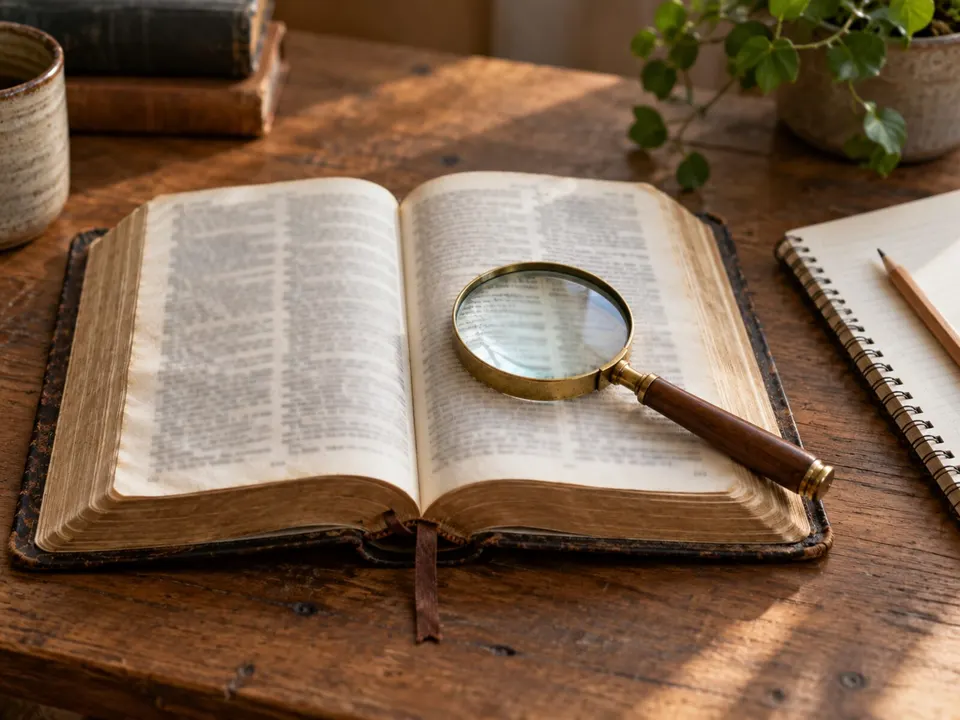
Faith is often pictured as a single leap, one moment when a person decides to believe and every question goes quiet. Real faith rarely works that way. It is more like a journey, a road walked one honest step at a time, where evidence leads to trust, trust grows into obedience, and a life lived God’s way quietly confirms that the road was true all along. God never asks us to stop thinking. He invites us to look, to weigh what we find, and to keep walking.
Start by naming your assumptions
Every one of us comes to a question with a set of assumptions already in place, and those assumptions decide in advance what we are willing to accept. Think of the man born blind in John 9. Jesus healed him, and the evidence was standing right there in front of everyone, a man who had never seen now seeing. Yet the religious leaders could not get to the truth, because they had decided ahead of time what kind of person Jesus could not be. The irony of the whole account is that the man who had been blind his entire life saw most clearly of all. When we are honest about the beliefs we carry into a question, we give the evidence a fair chance. When we are not, we can look straight at the answer and still miss it.
Faith rests on evidence, not on a blank guess
Biblical faith is not a wish with the lights off. Scripture describes it as “the assurance of things hoped for, the conviction of things not seen” (), a settled confidence that rests on real grounds. Paul writes that God’s “invisible attributes” have been “clearly perceived” in the things he has made, so that creation itself is a witness (). When John finished his account of the life of Jesus, he told us plainly why he wrote it down: “these are written so that you may believe that Jesus is the Christ, the Son of God” (). Faith and evidence were never enemies. One leans on the other.
A source you can trust
A journey of faith needs a reliable map. For the Christian that map is the word of God, “breathed out by God and profitable for teaching” (). It is the lamp that shows the next step, “a lamp to my feet and a light to my path” (). We do not trust the Scriptures because we feel strongly about them. We trust them because they have proven, again and again, to be true and dependable, and that credibility is what lets us keep walking even where the road is dim.
Honest doubt is part of the walk
Doubt is not the opposite of faith. It is often faith asking an honest question. A father once brought his son to Jesus and cried out, “I believe; help my unbelief” (), and Jesus did not turn him away. When Thomas struggled, Jesus met him with the evidence he needed and then said, “Blessed are those who have not seen and yet have believed” (). It helps to remember that not every question sits at the center of the faith. Some matters are worth studying but are not the ground we stand on. The heart of it is Christ, crucified and raised. When we keep first things first, we can hold our questions without fear. And when others ask us about our hope, we answer “with gentleness and respect” (), inviting them to look rather than forcing them to agree.
Trust turns into obedience
There is a point on the journey where believing becomes trusting, and trusting shows up in how we live. “Trust in the Lord with all your heart, and do not lean on your own understanding” (). That kind of trust is not passive. It gets up in the morning and does what God said, even before every outcome is clear. Obedience is simply faith with its shoes on, and it is where the road really gets traveled.
Blessing becomes new evidence
Here is the quiet surprise of the walk. When we live God’s way over time, the life that results becomes its own kind of evidence. “Oh, taste and see that the Lord is good” (). You cannot read that verse from a distance. You have to live it, through hard seasons as much as easy ones, and then look back and realize how much good came from the path. This is why the writer of Hebrews says God “rewards those who seek him” (). The blessings are not a bribe to believe. They are the fruit of a faith already walking, and they strengthen that faith for the next stretch of road.
Keep walking
A spiritual journey is not finished in a single afternoon. It moves from honest questions to real evidence, from evidence to a trustworthy word, from trust to daily obedience, and from a faithful life back to fresh confidence for the road ahead. Wherever you find yourself on that path today, the invitation is the same one Jesus has always given. Come and see, keep walking, and let each step prove the next one worth taking.