
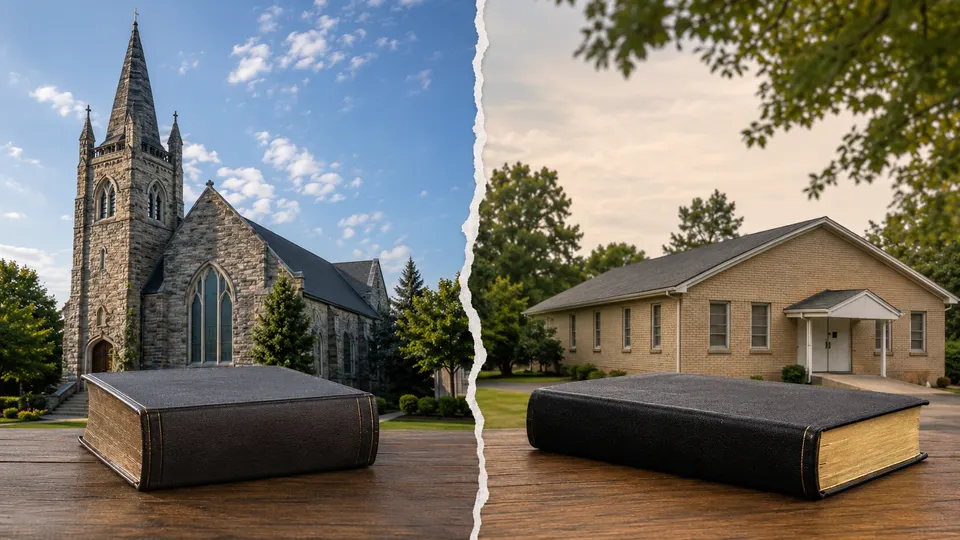
Presbyterian churches and churches of Christ share several important convictions. Both believe in Jesus Christ, value the Bible, and desire to honor God in the life of the church. Those areas of agreement deserve to be acknowledged before considering the differences.
The most significant differences concern salvation, baptism, church government, and the use of confessions of faith. These are not merely matters of custom. They arise from different understandings of what Scripture teaches.
Presbyterian denominations are not all alike, just as congregations using the name “Church of Christ” are not all alike. This article primarily describes historic Presbyterian teaching represented by the Westminster Confession of Faith and compares it with what we teach at Memorial Church of Christ.
Our purpose is not to speak disrespectfully of sincere people. It is to describe the differences fairly and encourage every reader to examine them in the light of God’s Word.
Where Did These Churches Come From?
Presbyterianism developed during the Protestant Reformation of the sixteenth century. Its theology was strongly influenced by John Calvin and other Reformed teachers, while John Knox played a leading role in establishing Presbyterianism in Scotland. The name Presbyterian refers to its form of government by elders, and the Westminster Confession of Faith, completed in the 1640s, became an important statement of Presbyterian doctrine.
The modern history of churches of Christ is associated with the Restoration Movement of the late eighteenth and early nineteenth centuries. Those involved in that movement called people to move beyond denominational divisions and return to the teaching and practice of the New Testament church.
That remains our aim today. We are not trying to establish a new denomination or follow the teachings of a particular human founder. We want to belong to the church Christ promised to build:
“On this rock I will build my church, and the gates of hell shall not prevail against it” ().
Our desire is to speak where Scripture speaks and allow God’s Word to govern what we believe and practice ().
Does God Choose in Advance Who Will Be Saved?
Historic Presbyterian theology is Calvinistic. It teaches that God chose particular individuals for salvation before the creation of the world, not because of faith or obedience He foresaw in them, but according to His sovereign will. It also teaches that those whom God has chosen and brought to salvation will persevere and cannot finally fall away.
Churches of Christ understand biblical election differently. The Bible certainly teaches predestination (), but we understand God to have predetermined the plan of salvation and the destiny of those who are in Christ. Everyone is genuinely invited to enter that saving relationship through faith and obedience to the gospel.
Paul wrote of:
“God our Savior, who desires all people to be saved and to come to the knowledge of the truth” ().
Peter similarly wrote that the Lord is:
“Not wishing that any should perish, but that all should reach repentance” ().
The final invitation of Scripture is extended freely:
“Let the one who desires take the water of life without price” ().
For these reasons, we believe God sincerely offers salvation to every person. He does not show partiality, but receives those who fear Him and respond to Him in obedient faith (). People become part of God’s chosen people by coming to Christ, and Scripture repeatedly warns believers against turning away from Him.
The difference is not whether the Bible teaches election; both groups believe that it does. The question is how that election works and whether God has made salvation genuinely available to everyone.
Who Governs the Church?
Both Presbyterian churches and churches of Christ recognize a role for elders. The principal difference is whether those elders govern only a local congregation or participate in a broader governing structure.
In Presbyterian government, the elders of a local church form a session. Local churches are connected through presbyteries, and broader matters may be handled by synods or a general assembly, depending on the denomination. These governing bodies can make decisions affecting multiple congregations.
Churches of Christ do not have governing bodies above the local congregation. Elders are appointed within each congregation and are responsible for shepherding that particular church (; ).
Peter instructed elders:
“Shepherd the flock of God that is among you” ().
We understand this to mean that elders oversee the congregation among them rather than exercising authority over other congregations. No earthly headquarters, convention, or general assembly governs churches of Christ. Christ alone is the head of His church ().
This local independence also means that no congregation can speak officially for every church using the name “Church of Christ.” We can explain what Memorial Church of Christ believes and practices, but each congregation is responsible before Christ for its own teaching and conduct.
Why Do They Practice Baptism Differently?
Presbyterian churches generally baptize both professing believers and the infant children of believers. They understand infant baptism as a sign of God’s covenant and view it as connected to the place children held within the covenant community in the Old Testament. Baptism may be administered by sprinkling, pouring, or immersion, although sprinkling and pouring are common.
Churches of Christ baptize people who have personally heard the gospel, believed in Jesus, and repented of their sins. We practice baptism by immersion and understand it to be part of a believer’s response to the gospel.
On the day of Pentecost, Peter told those who had been convicted by the message:
“Repent and be baptized every one of you in the name of Jesus Christ for the forgiveness of your sins” ().
Paul described baptism as a burial and resurrection with Christ:
“We were buried therefore with him by baptism into death, in order that, just as Christ was raised from the dead by the glory of the Father, we too might walk in newness of life” ().
We understand this burial language, together with the New Testament examples of baptism, to indicate immersion. We also believe repentance and faith must precede baptism. Because an infant cannot yet hear the gospel, believe it, or repent, churches of Christ do not practice infant baptism.
What Is the Final Standard for Doctrine?
Both Presbyterians and churches of Christ affirm the inspiration and authority of Scripture. The difference concerns the role given to formal confessions and catechisms.
Historic Presbyterian churches use the Westminster Confession and its catechisms as subordinate standards of doctrine. Presbyterians do not claim that these writings are inspired or equal to the Bible. Rather, they believe these documents accurately summarize the Bible’s teaching and provide a shared doctrinal standard for the church.
Churches of Christ do not adopt a human creed or confession as a binding standard of fellowship. We believe Scripture itself provides the church with everything necessary to know God’s will and live faithfully before Him:
“All Scripture is breathed out by God and profitable for teaching, for reproof, for correction, and for training in righteousness, that the man of God may be competent, equipped for every good work” ().
A confession may accurately repeat what Scripture says, but it cannot add authority to God’s Word. If it requires what Scripture does not require, it goes beyond the authority God has given it. For that reason, we seek to make the Bible itself our standard and to test every teaching directly against it.
The question is not whether a particular confession contains many true statements. The deeper question is whether any human document should function as an official doctrinal standard for Christ’s church.
Keep Examining the Scriptures
Do not accept these conclusions merely because we have stated them. Read Acts, Romans, Ephesians, and the other New Testament letters with these questions in mind. Consider how each position uses Scripture, and examine every claim, including ours, against the biblical text.
The people of Berea were commended because they were:
“Examining the Scriptures daily to see if these things were so” ().
Truth does not need to fear careful examination. Take the time you need, ask honest questions, and allow God’s Word to have the final say.
Examine God’s Word With Us
At Memorial Church of Christ, we would be glad to open the Bible and study this question with you. We will not single you out or ask you to make a decision before you understand what Scripture teaches.
Plan your visit, or bring your questions to us privately. Our desire is not to talk you into something, but to help you hear God’s Word and follow it with confidence.
If you would like to examine what the Bible teaches about becoming a Christian, start here.
When we meet:
- Sunday: Bible Class 9:00 am, Worship 10:00 am, Worship 6:00 pm
- Wednesday: Bible Class 7:00 pm