
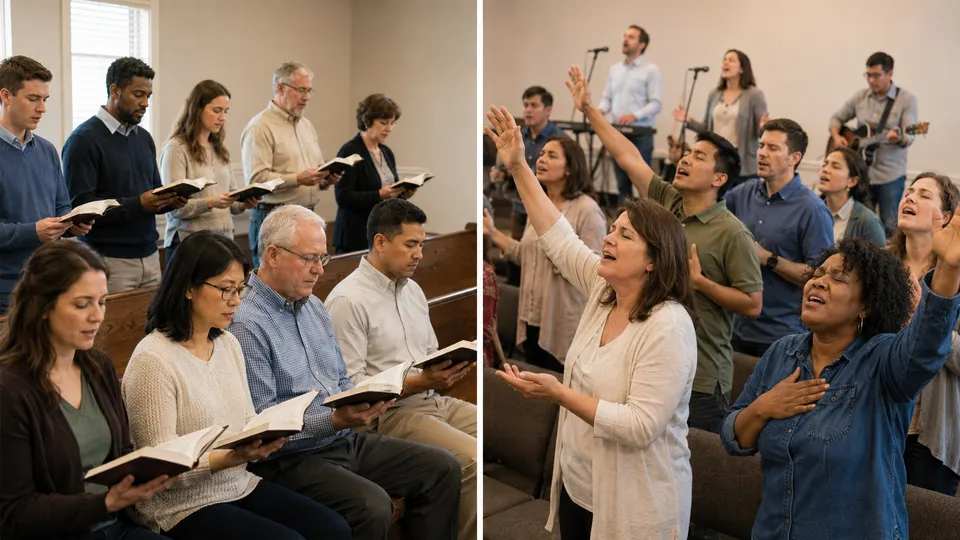
Churches of Christ and Pentecostal churches share several important convictions. Both believe in Jesus Christ, take the Bible seriously, value prayer, and desire to help people follow God. Many Pentecostal believers are deeply earnest about their faith, and that deserves to be acknowledged.
The clearest difference concerns miraculous spiritual gifts. Pentecostal churches generally teach that gifts such as speaking in tongues, prophecy, and miraculous healing continue today. Churches of Christ generally believe those gifts completed their purpose after God’s message had been fully revealed and confirmed.
That difference shapes much of what a visitor may notice, including the character of worship and what each group teaches about the work of the Holy Spirit.
Because Pentecostal churches vary widely, and churches of Christ have no central governing body, this article cannot describe every congregation. It explains common Pentecostal beliefs alongside what we teach and practice at Memorial Church of Christ.
Do Miraculous Gifts Such as Tongues Still Occur?
In the first century, miraculous gifts helped reveal and confirm that the message being preached came from God. The writer of Hebrews says that the gospel was confirmed by “signs and wonders and various miracles and by gifts of the Holy Spirit” ().
Paul also taught that these gifts would not continue indefinitely:
“As for prophecies, they will pass away; as for tongues, they will cease; as for knowledge, it will pass away. For we know in part and we prophesy in part, but when the perfect comes, the partial will pass away” ().
Churches of Christ commonly understand “the perfect” to refer to God’s completed revelation. The miraculous gifts provided truth in portions while that revelation was still being given. Once the faith had been “once for all delivered to the saints” (), those partial means of revelation had fulfilled their purpose.
Many Pentecostal believers understand “the perfect” differently, often connecting it with the return of Christ. That disagreement should be acknowledged and examined carefully from Scripture.
The way miraculous gifts were given also matters. Acts records that they were imparted through the laying on of the apostles’ hands (; ). We understand this to mean that when the apostles and those upon whom they had laid their hands were gone, the means of passing on those gifts was gone as well.
For these reasons, we do not seek miraculous gifts today. We believe they accomplished the work for which God gave them.
What Was Speaking in Tongues?
In Acts 2, speaking in tongues was the miraculous ability to speak languages the speakers had not learned. People from many nations were astonished because:
“Each one was hearing them speak in his own language” ().
They asked, “How is it that we hear, each of us in his own native language?” ().
Pentecostal Christians do not all explain modern tongues in the same way. Some understand them as human languages; others describe them as a spiritual or heavenly prayer language. Churches of Christ generally do not believe unintelligible or ecstatic speech corresponds to the languages described in Acts 2.
First Corinthians 12-14 also deserves careful study. Whatever conclusion one reaches, Paul taught that spiritual gifts were given to strengthen the church, not to elevate individuals or create confusion. Their use was governed by clear limits, because “God is not a God of confusion but of peace” ().
What Do Churches of Christ Believe the Holy Spirit Does Today?
Believing that miraculous gifts have ceased does not mean believing that the Holy Spirit is absent or inactive.
Peter promised those who repented and were baptized that they would “receive the gift of the Holy Spirit” (). The Spirit dwells in Christians, strengthens them, and helps form Christlike character within them.
Paul described the fruit of a Spirit-led life:
“The fruit of the Spirit is love, joy, peace, patience, kindness, goodness, faithfulness, gentleness, self-control” ().
The Spirit also helps Christians in their weakness and prayers (). God still hears prayer and works providentially in the lives of His people.
The difference, then, is not whether the Holy Spirit works today. It is whether He continues to give miraculous signs and new revelation as He did through the apostles in the first century. We believe the Spirit’s revealed Word is complete and sufficient to equip God’s people ().
How Is Worship Different?
Pentecostal worship varies from one congregation to another. It often includes instrumental music, raised hands, spontaneous prayers, personal testimonies, or invitations for healing. Some gatherings include what participants understand to be prophecy or speaking in tongues, while others are more reserved.
Worship at Memorial Church of Christ is simple and orderly. We sing without instrumental accompaniment, pray, give voluntarily, observe the Lord’s Supper every first day of the week, and hear preaching from Scripture.
We sing a cappella because the New Testament instructs Christians to sing:
“Addressing one another in psalms and hymns and spiritual songs, singing and making melody to the Lord with your heart” ().
We observe the Lord’s Supper on Sunday following the example of the disciples who assembled on the first day of the week to break bread (). We also seek to follow Paul’s instruction that “all things should be done decently and in order” ().
Orderly worship should not be cold or without feeling. Jesus taught that true worshipers must worship “in spirit and truth” (). Our desire is therefore to worship sincerely while allowing God’s truth to govern what we do.
How Is Each Church Organized?
Many Pentecostal congregations belong to denominations with regional or national leadership, although some are independent.
Churches of Christ have no governing organization above the local congregation. Each mature congregation is overseen by its own qualified elders (; ).
Peter told elders:
“Shepherd the flock of God that is among you” ().
We understand elders to oversee the congregation among them rather than exercising authority over other churches. No headquarters, convention, or denominational officer stands above the local congregation. Christ alone is the head of His church ().
This also means that Memorial cannot speak officially for every congregation using the name “Church of Christ.” We can only explain what we understand Scripture to teach and what we practice here.
How Should You Evaluate the Differences?
Do not decide merely by which worship service feels more powerful or emotionally moving. A spiritual experience may feel sincere and compelling, but feelings alone cannot determine what is true.
At the same time, do not accept our conclusions merely because we state them confidently. Read Acts 2 and Acts 8. Read 1 Corinthians 12-14 as one complete section. Ask what miraculous gifts were, how they were received, what purpose they served, and whether Scripture indicates that they would continue.
The people of Berea were commended for receiving the message eagerly while still “examining the Scriptures daily to see if these things were so” ().
Every church, including ours, should welcome that examination.
Examine God’s Word With Us
Our disagreement with Pentecostal teaching is real, but it does not give us permission to misrepresent sincere people or question their love for God. We want to speak truth plainly while treating others with the patience and dignity Christ requires.
At Memorial Church of Christ, we would be glad to open the Bible and study these questions with you. Bring your questions and compare every answer with God’s Word.
Plan your visit. Come as you are, worship with us, and ask us anything.
If you would like to examine what the Bible teaches about becoming a Christian, start here.
When we meet:
- Sunday: Bible Class 9:00 am, Worship 10:00 am, Worship 6:00 pm
- Wednesday: Bible Class 7:00 pm