
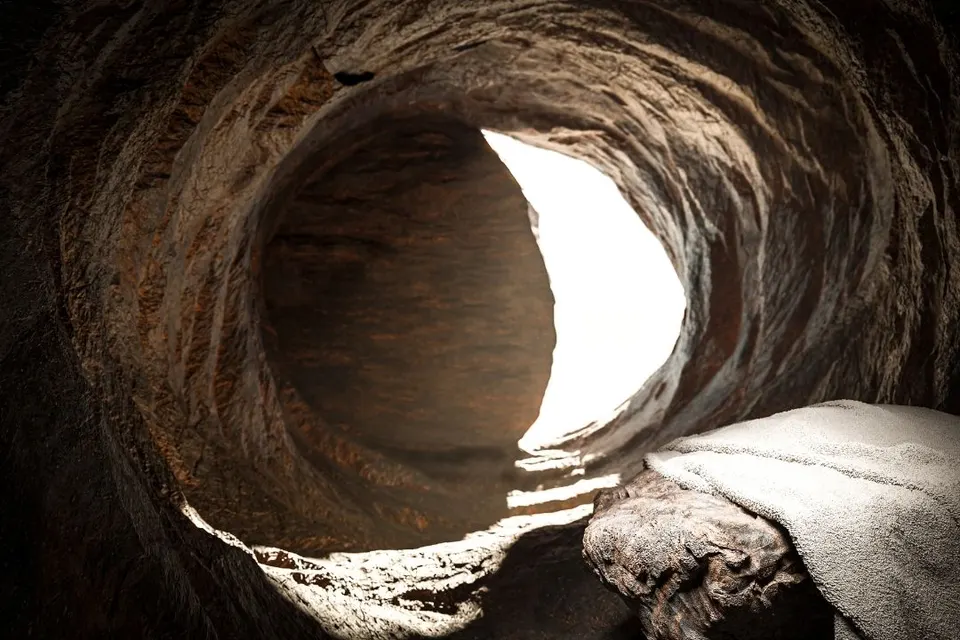
Sometimes a single event changes everything before anyone has time to process what just happened. In the days leading up to Passover, Jerusalem was filling with pilgrims from across Judea and beyond, all of them expecting the usual week. What they got instead was something the city had never seen: a man who had been dead for four days walking freely among them, alive, recognizable, and completely impossible to explain away.
The Sign Everyone Was Talking About
captures the atmosphere with quiet precision: the large crowd came not only to see Jesus but also to see Lazarus. This detail matters. Lazarus was not a name people knew only from a secondhand report. He was physically present, two miles from Jerusalem in Bethany, during the most crowded week of the year. Pilgrims had traveled from across the region. Witnesses from the tomb were still retelling it. A man who had been sealed in a grave long enough that his family warned of decay was standing in full health.
No one had to take it on faith. They could go see for themselves.
John notes that the crowd bearing witness kept bearing witness, even after the triumphal entry, even after the palm branches had settled. The early disciples, when commanded to stop speaking, would later say to the authorities: “We cannot but speak of what we have seen and heard” (). That instinct runs through this whole scene. People spread the stories they know to be true. The resurrection had entered the public square and it was not going back.
Two Kinds of Response
The same event, the same evidence, produced two completely different reactions. records that many who had been with Mary at the tomb and witnessed what Jesus did believed in him. But verse 46 follows immediately: others went and told the Pharisees.
The religious leaders gathered a council and laid out their fear plainly: “If we let him go on like this, everyone will believe in him, and the Romans will come and take away both our place and our nation” (). These are not men who doubted the facts. Their own words confirm they knew what had happened. Their problem was not unbelief in the evidence. It was the threat that evidence posed to everything they had built their lives around.
So they responded not with surrender but with a plan. records that the chief priests made plans to put Lazarus to death as well, because his living presence kept drawing people toward belief in Jesus. A resurrected man was to be killed again to protect an institution. It is one of the most revealing moments in the Gospels: men choosing to fight against a truth they cannot deny rather than yield to it.
What the Resurrection Changes About Being Alive
Consider two worlds. In one, death is final and there is nothing after. If that is true, survival becomes the highest value. How long you live, how much you accumulate, how well you protect your comfort becomes the organizing principle of human life. Every choice tilts toward self-preservation because nothing outlasts the grave.
But if the resurrection is real, human life is not a closed system. The grave is not the end. Which means how you treat people carries permanent weight. How you handle suffering has context beyond the immediate pain. Holiness is not arbitrary. Judgment is not a metaphor. Life has direction and accountability that stretches beyond what can be measured in days or years.
Jesus said in John 5 that an hour is coming when all who are in the tombs will hear his voice and come out. Lazarus heard that voice and came out. He was a singular case, a preview of something universal. Every person will hear that voice. The question Lazarus’ living presence posed to everyone who encountered him is not whether it happened. The question is what to do with it.
A Testimony That Could Not Be Buried
Lazarus did not write a defense of the resurrection. He did not publish an argument. He simply lived, which was argument enough. He walked around Jerusalem during Passover week while thousands were present to observe him. His presence was testimony that could not be dismissed, forged, or reasoned away. Powerful men wanted to bury him a second time specifically because he was so convincing.
That kind of testimony does not depend on eloquence. It depends on something having genuinely happened. And when something has genuinely happened, especially something of that magnitude, it rearranges how a person lives going forward. Suffering is framed differently. Fear loses some of its grip. Priorities reorder themselves around what will actually last.
The triumphal entry, the crowd crying out “Hosanna! Blessed is he who comes in the name of the Lord, even the King of Israel!” (), did not happen in a vacuum. It happened in a city where a dead man was walking. The resurrection created the atmosphere that made that entrance possible.
It still does.