
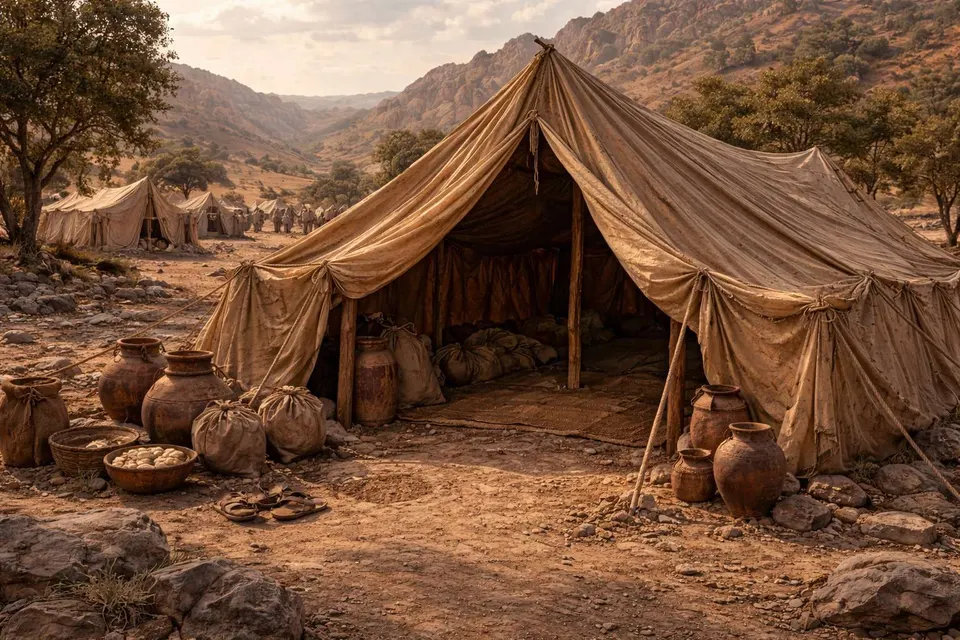
There is something deeply unsettling about the story of Achan in Joshua 7, and it is not just the dramatic ending. It is the ordinary beginning. A man saw something he wanted. He took it. He buried it. He went about his life as if nothing had happened. That sequence is not ancient history. It plays out quietly in hearts today, and the story exists in our Bibles precisely because God wants us to learn what concealed sin always eventually costs.
A Moment Nobody Else Saw
The fall of Jericho had been extraordinary. The walls came down by the power of God, and the surrounding nations trembled. Israel was at a high point. But in the middle of that victory, one man’s private decision began unraveling everything. God’s instruction had been direct: the city and everything in it was devoted to destruction. Nothing was to be kept (). Achan understood the command. He chose differently anyway.
His own confession in walks through the progression with painful clarity. He saw a beautiful cloak, silver, and gold. He coveted them. He took them. He hid them under the floor of his tent. describes this exact pattern: desire forms, then it conceives sin, and sin when fully grown brings death. There is nothing new under the sun. The steps that led Achan to ruin are the same steps that lead anyone away from God and into the darkness of concealment.
What makes his choice so striking is what he did next. He buried the stolen goods and slept on top of them. He kept living among his people, standing in assembly, participating in the life of the community, while something was hidden underneath the surface of his life that did not belong there. That image is worth sitting with. It is possible to appear completely intact on the outside while something dangerous is quietly buried within.
Nothing Is Hidden from God
Guilt has a particular way of redirecting our attention. We look around to see who might have noticed. We manage appearances. We grow careful. What Achan’s story illustrates, and what God makes unmistakable, is that we look in every direction except upward. states that “the eyes of the Lord are in every place, keeping watch on the evil and the good.” goes further: no creature is hidden from his sight, but all are exposed to the eyes of the one to whom we must give account.
God’s process of exposing Achan was deliberate and public. Tribe by tribe, clan by clan, household by household, the circle narrowed in front of the entire nation of Israel (). Achan stood there through the whole process, saying nothing, waiting to see if the lot would pass him by. It did not. What he had guarded so carefully in private became known before everyone.
Jesus warned plainly about this reality in , that nothing covered up will stay hidden, and what is whispered in private rooms will eventually be proclaimed. The question is never whether hidden sin will surface. The question is only whether we will bring it into the light ourselves, or whether God will.
Sin Never Stays in the Tent
One of the most sobering dimensions of Achan’s story is how far the consequences traveled from the original act. Joshua sent roughly three thousand men to take the small city of Ai, a straightforward mission by all appearances. Thirty-six of them died. Israel fled (). An entire army’s confidence collapsed. Hearts that had been bold melted like water.
None of those thirty-six men had anything to do with what was buried under Achan’s tent. They did not know. They paid anyway. Paul’s words in acknowledge this painful feature of sin: it entered the world through one man and spread outward in ways no one can fully contain. A single person’s concealed choices send consequences into the lives of people they never intended to harm.
Paul made the same point to the Corinthians when he described unaddressed sin in a community as leaven working through a whole lump of dough (). Sin may be unseen, but it is never inactive. It weakens what it touches. And the people closest to us, families, congregations, communities, absorb the weight of choices they never knew were being made.
The Way Out Is Through Honesty
The end of Achan’s account is severe, and the text does not soften it. But buried within the tragedy is a clear path that he could have taken and chose not to. He could have confessed before Joshua called the lots. He could have stepped forward at any point during that long, narrowing process. Confession was available to him, and he stayed silent until there was no other option.
The contrast Scripture offers is striking. calls us to repent and turn back so that sins may be blotted out. and promise that if we walk in the light as God is in the light, the blood of Jesus cleanses us from all sin, and if we confess our sins, he is faithful and just to forgive and cleanse us from all unrighteousness. The path to freedom is not concealment. It is honest exposure before the God who already knows everything anyway.
What is buried in your tent right now? Only you and God know the answer to that question. The account of Achan is in the Scriptures not to frighten us into paralysis but to move us toward the one response that actually works. What stays hidden destroys. What is brought into the light can be forgiven and made right. That offer is still open.