
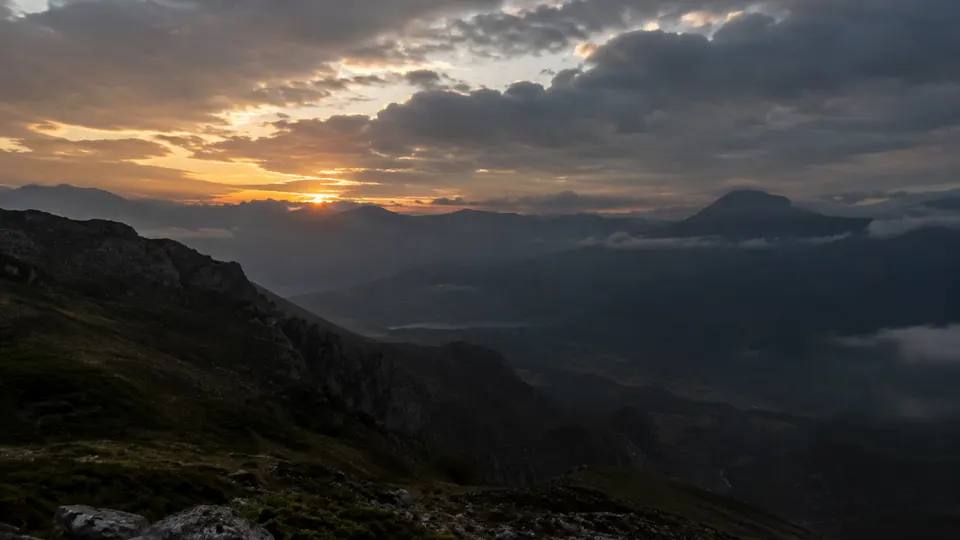
There is a particular kind of dark that has nothing to do with the hour of the night. It is the dark that settles in when a diagnosis comes back wrong, when a marriage is unraveling, when a job disappears, when a friend stops answering. In that kind of dark, the question that surfaces is not really “what do I do now.” It is “where did God go.”
A Story Where God’s Name Never Appears
The book of Esther answers that question in an unusual way. It never once mentions God’s name, not a single time in ten chapters. And yet it may be the clearest picture in the Old Testament of God working precisely when he seems most absent. The setup is genuinely dark. A man named Haman, second in command over the entire Persian empire, secures a decree to destroy every Jewish person across a hundred and twenty seven provinces, all in a single day (). An entire people are living under a sentence of death, with no army, no political power, and no visible way out.
Then the story turns, almost by accident. The king cannot sleep one night, so he asks for the official records to be read to him, and he happens to hear about a good deed done by a Jewish man named Mordecai, Esther’s uncle, that had never been rewarded (). That one sleepless night becomes the hinge the entire story swings on. Haman is exposed and removed, Mordecai rises to his place, and by the text says plainly that “the Jews had light and gladness and joy and honor.” The very people who had no hope are the ones the light finally reaches. God’s fingerprints are everywhere in that story. His name is nowhere in it.
Two Things That Can Be True at Once
It helps to hold onto a simple truth: two things can be true at the same time. A person can be confident in a decision and still feel nervous about what comes next. A person can be genuinely grateful and still be grieving. Darkness can be completely real, and God can still be completely present and completely at work. Neither cancels the other out.
Paul put words to this in : “For we walk by faith and not by sight.” Sight looks at the circumstances and says there is no way forward. Faith does not deny what sight sees. It simply refuses to let what can presently be seen become the final measure of what is true. David wrote from the same place in , walking through the valley of the shadow of death and still able to say, “I will fear no evil, for you are with me.” The shadow was real. So was the presence.
Why Darkness Distorts More Than It Destroys
Darkness has a way of changing what a person believes is true, even when nothing has actually changed. A shape in a dark room can look like a monster until the light comes on, and then it turns out to be nothing more than a backpack hanging on a door. The room never changed. Only what could be seen in it changed. Spiritual darkness works the same way. A season of fear or confusion can distort what a person believes about God, about themselves, about whether anything will get better, even while none of it has actually shifted. Paul described Christians in as “sorrowful, yet always rejoicing.” Grief and hope are allowed to sit in the same room together.
Even the disciples were not exempt from this. After the resurrection, when Jesus met them on the mountain in Galilee, Matthew records that they worshiped him, “but some doubted” (). Worship and doubt showed up in the very same moment, in the very same room. The response to lingering darkness was not to wait until every doubt cleared up. It was to keep showing up, keep worshiping, keep staying close to the people who believed.
Made for a Time Like This
Esther’s uncle Mordecai said something to her that has outlasted the rest of the story: “Who knows whether you have not come to the kingdom for such a time as this?” (). It is worth turning that question toward an ordinary life. A hard season at home, a difficult stretch at work, a friendship strained by conflict, any one of those could be the very place a person was placed on purpose, for such a time as that.
Darkness will keep showing up. That has never been in question. What is worth remembering is that darkness only changes what can be seen. It does not change what is true. God is still on his throne, still sovereign, still steadfast, whether or not the room feels lit. The sun is going to come up. It always does. And the same God who never once said his own name out loud in the book of Esther was never once absent from it either.